Custom Builder or Production Builder in Lehi: What the Choice Actually Determines
Drive through Lehi today and you will pass subdivisions built from a catalog of a dozen floor plans alongside individual lots where a single home was designed from a blank sheet of paper for the family that will live in it. Both are legitimate ways to build a house. They are not, however, the same decision wearing different clothes. A production builder and a custom builder solve different problems, serve different priorities, and produce homes that age differently over the decades a family actually lives in them.
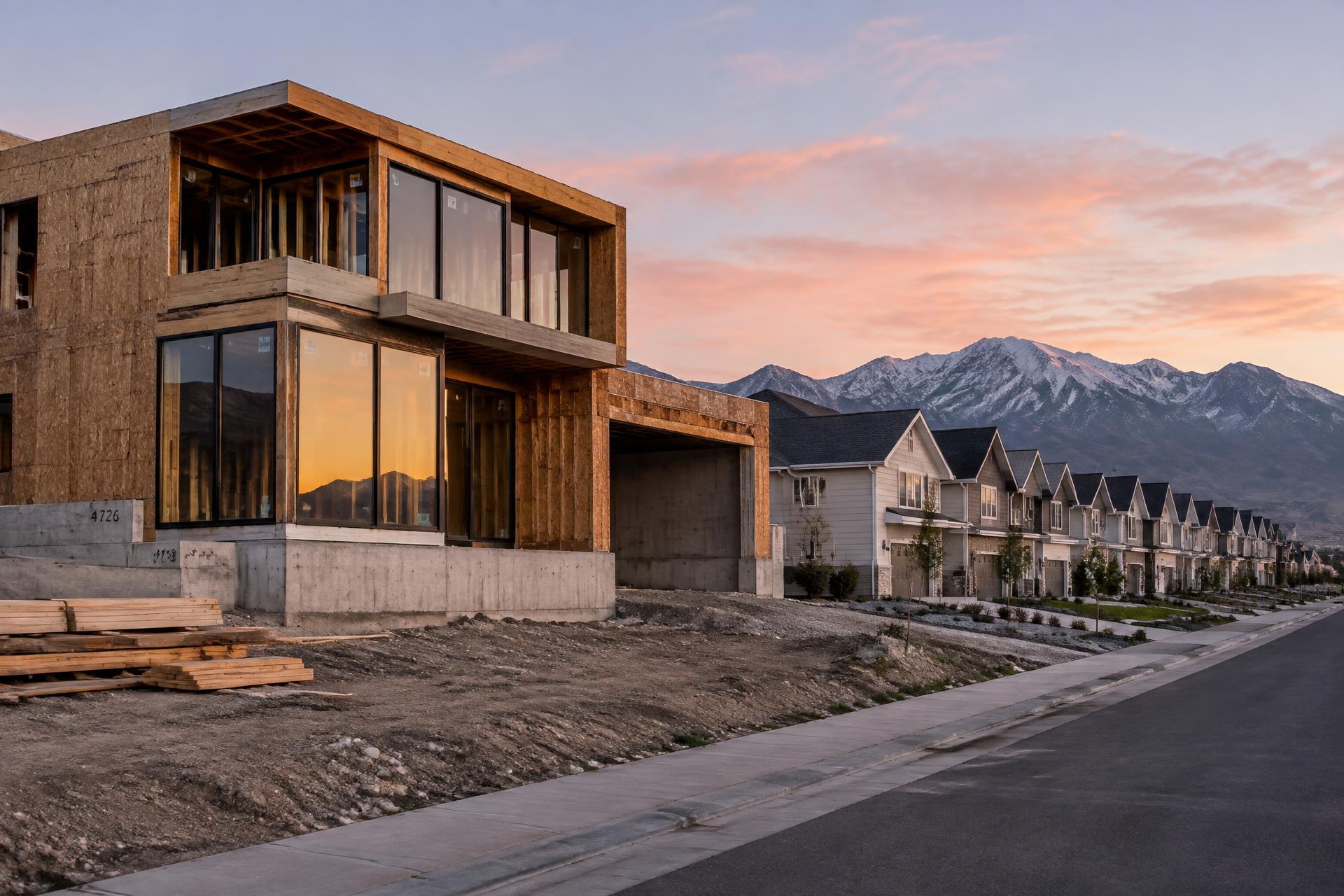
Lehi is an unusually clarifying place to examine this choice because the market contains both extremes in close proximity. Near Thanksgiving Point and along the benches climbing toward Traverse Mountain, custom lots sit within a few miles of large production communities offering a limited set of plans at speed and scale. Understanding what each path actually offers, rather than what either label implies, is the first real decision a Lehi homebuyer makes.
What is the real difference between a custom builder and a production builder?
A custom builder designs a home around a specific lot and a specific homeowner's priorities, while a production builder builds a limited set of predetermined plans across many lots to achieve speed and cost efficiency at scale. Neither approach is inherently better in the abstract. They are built for different goals, and the right choice depends on what the homeowner actually values most.
A production builder's efficiency comes from repetition. The same floor plan, built dozens of times with the same materials ordered in bulk and the same trade crews moving from lot to lot, is genuinely faster and often less expensive per square foot than a one-off design. A custom builder's value comes from the opposite discipline, treating the lot, the view, the family's daily patterns, and the long-term use of the home as design inputs rather than variables to be standardized away.
Why does lot condition matter more in Lehi than elsewhere?
Lot condition matters intensely in Lehi because the city spans flat valley ground, rolling hillside benches near Traverse Mountain, and infill lots near Thanksgiving Point, and a single floor plan rarely serves all three well. A production plan is designed to work reasonably across a range of flat, similarly graded lots within one subdivision. It is not designed for a sloped Traverse Mountain parcel with a specific view corridor, and forcing it onto one usually means the view, the grade, or the design suffers.
A custom builder starts from the opposite direction, walking the specific lot before drawing anything, studying where the sun falls through the day, where the best sightlines toward the mountains or the valley actually are, and how the grade wants to be built with rather than against. On a distinctive Lehi lot, that difference in approach shows up permanently in how the finished home relates to its setting.
How does the design and decision process differ between the two?
A production builder offers a limited menu of pre-approved options within a set floor plan, while a custom builder works from a blank page and resolves the design collaboratively before construction begins. In a production process, the homeowner selects from a finite list of finishes and layout options that have already been engineered and priced across the entire community. The system is efficient precisely because the number of decisions is limited.
A custom process asks more of the homeowner up front, working through room adjacencies, ceiling heights, window placement, and material palette as open questions rather than a checklist. That additional time at the front of the project is precisely what allows the finished home to reflect how a specific family actually lives, rather than how an average buyer is assumed to live. Our own design phase is outlined on our build process page.
Does a custom home in Lehi always cost more than a production home?
A custom home generally costs more than a comparable production home, but the gap reflects real differences in design time, material selection, and structural individuality rather than markup for its own sake. Production pricing benefits from the scale of building the same plan repeatedly, an efficiency a one-off custom design cannot replicate by definition.
What that comparison leaves out is the long-term picture. A custom home designed around a difficult or distinctive Lehi lot, particularly a hillside parcel, often performs better against that specific site than a production plan adapted to fit it, which can mean fewer compromises and fewer costly corrections later. For a full breakdown of where custom construction spends its budget, see our companion piece on what a custom home costs in Lehi.
What does a Traverse Mountain or Thanksgiving Point lot actually require?
A Traverse Mountain lot typically requires slope-responsive foundation design and a plan built around a specific view corridor, while a Thanksgiving Point lot often calls for a design that responds to proximity, density, and a more curated architectural context. These are two of Lehi's most distinctive settings, and each rewards a design process that begins with the site rather than with a plan already drawn.
On Traverse Mountain, grade is the defining fact of the lot. A home designed to step with the hillside, with a walkout lower level and rooflines that respond to the slope, will feel settled into the land in a way a flat-lot plan simply cannot replicate no matter how it is modified after the fact. Near Thanksgiving Point, the defining fact is often context, a tighter lot fabric and a more visible relationship to neighboring homes, both of which reward considered massing and material choices over a repeated template.
How does the choice affect resale value in Lehi's market?
A well-designed custom home in a distinctive Lehi setting tends to hold and distinguish its value over time because its design intent is specific to the lot, while production homes compete more directly on price against dozens of similar homes nearby. That is not a criticism of production construction, which serves an important part of the market well. It is simply a different competitive position at resale.
A future buyer touring a custom home on a Traverse Mountain view lot is evaluating something that cannot be replicated a few streets over. A buyer touring a production home is often comparing it, consciously or not, to several nearly identical homes within walking distance. Neither position is automatically better for every seller, but a homeowner should understand which position their home occupies before making the choice.
Who is production building actually right for, and who should choose custom?
Production building suits a buyer who values speed, predictable pricing, and a proven floor plan on a straightforward lot, while custom building suits a buyer with a distinctive lot, specific design priorities, or a long time horizon in the home. Both are reasonable answers to different questions, and the honest first step is figuring out which question actually applies.
A homeowner who has secured a hillside lot on Traverse Mountain with a view worth building around, or who has a specific way of living that no existing floor plan accommodates, is generally better served by a custom process. Homeowners weighing that decision against their lot and budget are welcome to contact Modern International Builders for a direct conversation, and homeowners still evaluating land should read our guide on buying land for a custom home in Lehi before making an offer.
The full economics of that decision, including where the money actually goes, are covered in our pillar article on custom home costs in Lehi. Our own approach to custom construction is described on the services page.
Frequently asked questions about custom versus production building in Lehi
Can I modify a production floor plan enough to make it feel custom?
Most production builders allow a limited set of structural and finish modifications, but the underlying plan, room proportions, and site orientation typically remain fixed. Meaningful changes to layout, ceiling volume, or the home's relationship to the lot are usually outside what a production process is set up to accommodate, which is where the two paths genuinely diverge.
Is a semi-custom builder a middle ground worth considering in Lehi?
Semi-custom builders offer more flexibility than a strict production model but still typically start from a base plan rather than a blank site analysis. For a flat, conventional lot, that middle ground can work well. For a distinctive Lehi site, particularly a hillside or view lot, it often reintroduces the same compromises a fully custom process is designed to avoid.
Does a custom build take significantly longer than a production home?
Yes, generally, because a custom home includes a design phase that a production home skips entirely by reusing an existing plan. That additional time up front is discussed in detail in our article on how long a custom home takes to build in Lehi, and it is time spent resolving decisions before construction rather than during it.
Do production builders ever build on Traverse Mountain lots?
Some production and semi-custom builders do work on sloped lots, but the plan is typically adapted from a flat-lot base rather than designed from the grade upward. The result can work adequately, but it rarely captures a hillside view or responds to the slope as effectively as a plan conceived for that specific site from the start.
Modern International Builders
Utah's premier custom home builder, specializing in luxury residences throughout Park City, Alpine, Highland, and Draper. With over 20 years of experience, we transform visions into exceptional living spaces.
Learn more about our team →