
Buying Land for a Custom Home in Lehi: What to Evaluate Before You Sign
A homeowner rarely buys a house lot in Lehi with a full understanding of what they are actually purchasing. They see a view, a location relative to work or schools, and a price, and those three factors carry most of the emotional weight of the decision. What they often do not see, because it is not visible on a walkthrough, is the slope beneath the surface soil, the geotechnical condition that determines foundation cost, the exact boundaries of the view corridor that will or will not survive future development next door, and the entitlement status that determines what can legally be built at all.
Lehi's geography makes this evaluation more consequential than in a flatter market. The city rises from valley floor near the freeway toward hillside benches east of I-15 and toward Traverse Mountain, and that rise brings both the views that make custom building here worthwhile and the site complications that make due diligence essential. A lot that looks straightforward from the road can carry costs that surface only after closing, when there is far less leverage to address them.
What should be evaluated before making an offer on a Lehi lot?
Before making an offer on a Lehi lot, a buyer should evaluate slope and drainage, soil condition, utility access, view corridor stability, and the entitlement or zoning status of the parcel. Each of these factors affects either what can be built, what it will cost to build it, or both, and each is far easier to investigate before closing than after.
Most of this evaluation should happen with the builder involved, not after the fact. A builder who has worked lots across Lehi's varied terrain, from the flatter parcels near downtown to the benches climbing east toward the mountain, can often spot a costly site condition during a single walkthrough that a buyer touring alone would miss entirely.
Why do hillside lots east of I-15 require special evaluation?
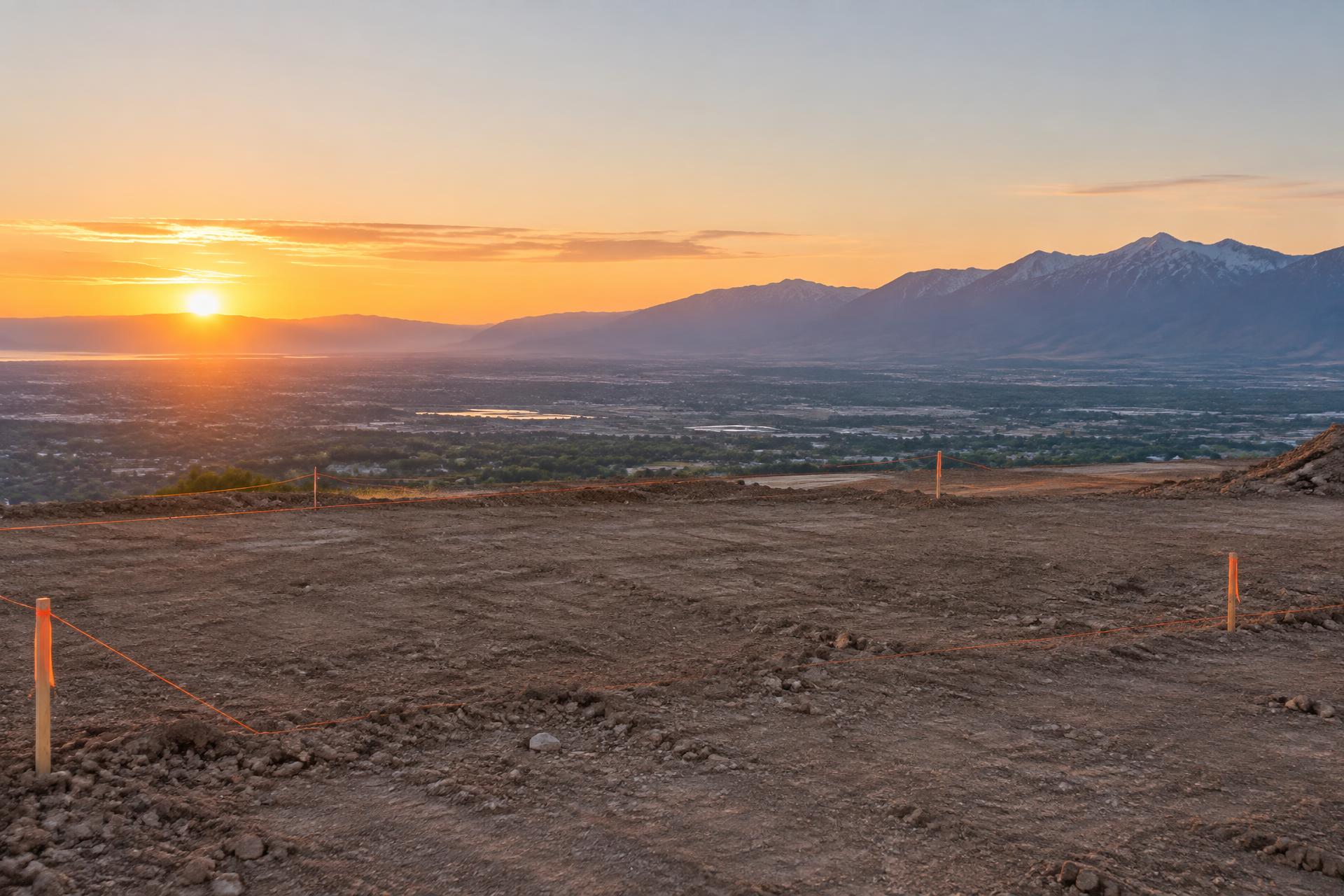
Hillside lots east of I-15 in Lehi require special evaluation because slope directly determines foundation type, retaining wall scope, driveway grade, and how much of the buildable envelope is actually usable, and these factors are rarely obvious from a casual site visit. A lot that appears to offer a generous building pad on a plat map may, once surveyed, reveal a much smaller flat area once setbacks and slope stability requirements are applied.
Steeper hillside parcels often require engineered retaining structures simply to create a stable pad, and the driveway itself becomes a design problem rather than an afterthought, since grade limits and snow performance both have to be resolved. None of this makes a hillside lot a poor choice. These benches offer some of the best views available in Lehi. It does mean the evaluation has to go beyond the view and into the mechanics of building on the specific slope.
How do you protect a view corridor before you own the lot?
Protecting a view corridor before purchase means researching the zoning and any recorded restrictions on adjacent and downhill parcels, since a view that exists today can be partially or fully blocked by future construction on a neighboring lot. A beautiful view from an empty lot is not the same guarantee as a beautiful view from a completed home, particularly in a fast-growing city where surrounding parcels may still be undeveloped.
This research should include checking height restrictions, setback requirements, and any HOA or design review standards that govern surrounding lots, along with a realistic look at which nearby parcels remain undeveloped and what could eventually be built on them. A design-first builder will often walk the lot at multiple times of day and from multiple angles before finalizing a home's orientation, precisely to understand which sightlines are durable and which are dependent on conditions that could change.
What does a soils report reveal that a walkthrough cannot?
A soils report reveals subsurface conditions such as expansive clay, unstable fill, groundwater depth, and bearing capacity, none of which can be assessed by looking at or walking a lot. These conditions directly determine foundation type and depth, and in some cases they determine whether a specific design, particularly one with a basement or walkout level, is feasible at all without significant additional cost.
Lehi's geology is not uniform across the city, and a soils condition that is straightforward on one lot can be considerably more complex on a lot a few hundred feet away. Ordering a geotechnical evaluation before closing, or at minimum before finalizing design, protects a buyer from a foundation cost surprise that arrives after the point where walking away is a realistic option.
What entitlement and zoning questions matter most in Lehi?
The entitlement and zoning questions that matter most in Lehi involve confirming the parcel is properly platted for residential construction, understanding any HOA architectural review requirements, and verifying setback, height, and lot coverage limits before design begins. A lot that appears buildable can still carry restrictions that meaningfully constrain the home that can actually be placed on it.
Newer developments near Traverse Mountain and Thanksgiving Point often carry design review standards intended to maintain a consistent architectural character, and those standards should be understood before a design is drawn rather than after a submission is returned with required changes. Older infill lots closer to downtown Lehi can carry their own complications, including easements, shared access agreements, or nonconforming lot dimensions that require variance review.
Why should a builder be involved before a lot purchase closes?
A builder should be involved before a lot purchase closes because a builder can identify site costs and design constraints during a walkthrough that most buyers and even most real estate agents will not catch, and that knowledge changes what a buyer is willing to pay or whether they should proceed at all. By the time a lot has closed, the leverage to negotiate price based on a difficult soils condition or a compromised view corridor has largely disappeared.
This is a standard part of how we approach new land inquiries. A walkthrough before an offer is submitted, paired with a frank conversation about likely site costs, gives a buyer the information needed to negotiate from strength rather than discover problems from weakness. Homeowners evaluating a specific Lehi parcel are welcome to contact Modern International Builders before making an offer.
Once a lot is secured, the cost implications of its specific conditions feed directly into the budget conversation covered in our article on what a custom home costs in Lehi, and the site work itself becomes one of the first phases described in our article on how long a custom home takes to build in Lehi.
How does lot selection connect to the design of the eventual home?
Lot selection connects directly to home design because the slope, orientation, soil condition, and view corridor of the specific parcel should shape the floor plan, foundation type, and massing of the home rather than being worked around after the fact. A design-first approach treats the lot as the first design input, not as a backdrop for a plan drawn independently of it.
This is the argument, ultimately, for buying land and choosing a design partner together rather than sequentially. A homeowner who understands both the lot and the design possibilities it supports is in a far stronger position than one who purchases first and hopes the design will accommodate whatever the lot turns out to require. More on how a custom process differs from a standardized one is covered in our article comparing custom and production builders in Lehi. Our overall approach is described on the services page.
Frequently asked questions about buying land for a custom home in Lehi
Should I order a soils report before or after making an offer?
Where possible, a soils report or at least a preliminary geotechnical assessment should be made a contingency of the purchase agreement, allowing the buyer to review findings before the deal becomes final. If that is not feasible, ordering the report immediately after closing, before finalizing any design, is the next best option.
Can a view corridor be protected legally in Lehi?
In some cases, recorded easements or HOA covenants can offer partial protection, but a true legal guarantee of an unobstructed view is uncommon outside of specific development agreements. The more reliable protection is understanding zoning limits on neighboring parcels and building with realistic expectations about what could change around the lot over time.
How much more does a hillside lot typically add to site development cost?
The added cost varies significantly by slope severity and soil condition, which is exactly why a general figure is unreliable and a site-specific evaluation matters. A gently sloped lot may add relatively modest site costs, while a steep bench lot requiring substantial retaining structure can add considerably more, and only a walkthrough and engineering review will produce an accurate number.
Is an infill lot near downtown Lehi easier to build on than a hillside lot?
Often, yes, from a slope and foundation standpoint, but infill lots bring their own due diligence needs, including checking for easements, older utility infrastructure, and lot dimensions that may require variances for a larger custom home. Easier is not the same as free of complications, and each lot type simply shifts where the due diligence needs to focus.
Modern International Builders
Utah's premier custom home builder, specializing in luxury residences throughout Park City, Alpine, Highland, and Draper. With over 20 years of experience, we transform visions into exceptional living spaces.
Learn more about our team →