
Deck ROI in Utah: What a Custom Outdoor Room Actually Returns at Resale
A deck should do more than look better. It should return value. In Utah's premium markets, the difference between a deck that adds resale value and a deck that quietly erodes it is almost entirely a design decision made long before the first board is cut. Most homeowners assume the financial outcome of a deck is decided by what it cost to build. It is actually decided by whether the deck reads as part of the home or as something attached to it.
This is the part of the deck conversation the Utah market rarely treats with honesty. The numbers cited in national remodeling studies, the percentage of cost recouped at resale, are averages across markets that look nothing like Park City, Alpine, Highland, or Draper. In Utah's view-lot tier, a deck is not a backyard amenity. It is often the property's signature room, and the buyer is paying for it as such. That changes the financial math in both directions. A great deck returns far more than the national average implies. A weak deck returns far less.
Why does a design-first deck return more than a contractor platform?
A design-first deck returns more than a contractor platform because it reads as living space, photographs as a room, and extends the home's usable footprint in a way a future buyer can value directly. A contractor platform reads as a yard feature, photographs as an empty wood plane, and quietly tells the buyer that the outdoor room is something they would need to build themselves.
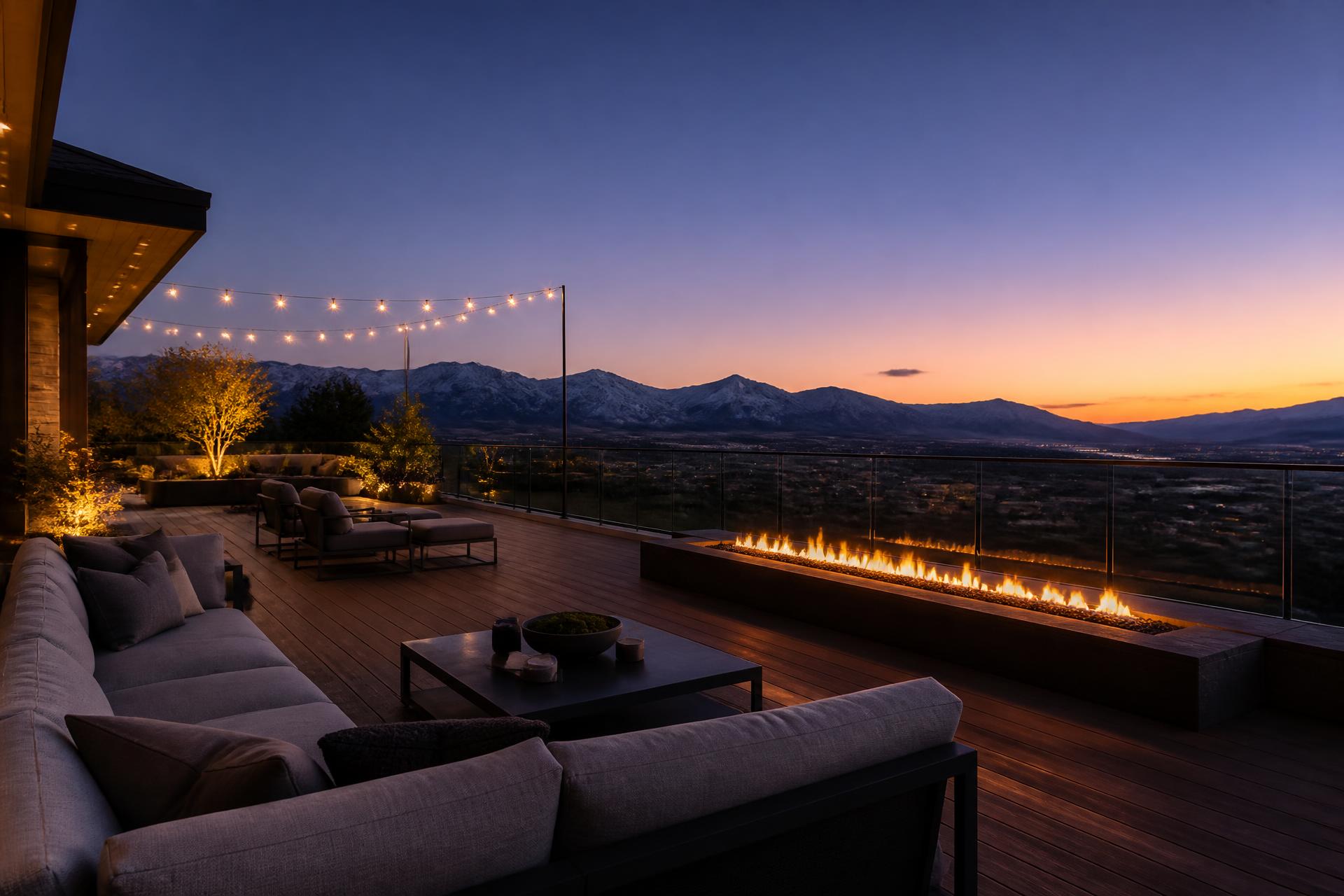
The reasons are visible to anyone who has scrolled through a luxury Utah listing. A design-first deck has scale that matches the great room behind it, so the eye reads them as one space. It has a clear furniture plan, often anchored by a fire feature and framed by a glass guardrail that does not obstruct the view. The board direction relates to the architecture rather than ignoring it. The transition from interior floor to exterior deck is flush and intentional. Each of these decisions photographs well, and what photographs well sells. The same listing without these moves shows a deck that looks smaller than it is, less considered than it is, and disconnected from the home, all of which depress what a buyer will pay.
There is also a felt-experience difference at showings. A buyer walks onto a design-first deck and pauses. They imagine sitting there in October with a glass of wine and the mountains in front of them. They imagine the family in summer. They imagine the holiday photographs. That mental picture is what they pay for. A contractor platform does not produce it.
What erodes deck ROI in Utah specifically?
The fastest ways to erode deck ROI in Utah are visible seams in the field, undersized footings that cause movement and noise, materials that fade or warp under UV and freeze-thaw, and a deck whose geometry has no relationship to the architecture it is attached to. Each of these signals to a sophisticated buyer that the deck was built to a budget rather than to a vision, and the price they are willing to pay adjusts accordingly.
Seams are perhaps the single most visible offender. A field of short, butt-jointed boards is the deck-building equivalent of a patched road. The eye sees the seams immediately and reads them as an aging surface, even on a deck only a few years old. Long, continuous boards, run with intentional joinery and a picture-framed perimeter, read as a finished room. Specifying them is a design decision made in the drawings, not in the field.
Undersized footings show up as movement, bounce, and creak. A buyer walking a deck that flexes underfoot reads the structure as questionable, even if the rest of the home is excellent. Footings sized correctly for Utah's frost depth and the deck's actual loads, including snow load and live load for outdoor gatherings, produce a deck that feels as solid as the home. The cost difference at construction is small. The cost difference at resale is not.
Material performance is the third erosion path, and Utah punishes weak material choices harder than almost any other market in the country. UV intensity at elevation fades wood and lower-tier composites faster than buyers expect. Freeze-thaw cycles open cracks that water then exploits. By year five, a deck specified to a price rather than to a climate has visibly aged, and the listing photograph shows it. For the material performance frame in detail, see our perspective on deck materials for Utah's climate.
How does the Alpine and Highland buyer context change the math?
In Alpine and Highland, the deck is often the property's signature feature, which means the financial impact of getting it right is larger and the cost of getting it wrong is larger as well. These are view-lot markets. The buyer is paying for the view. The deck is the room from which the view is consumed. When that room is correct, it carries the entire property's value upward. When that room is wrong, no amount of interior finishing fully compensates.
This is why a generic deck specification, ported from a flat-lot market, underperforms so badly in Alpine and Highland. A flat-lot deck does not need to negotiate grade, does not need to step with the slope, does not need to cantilever to catch the view that the back wall of the house is not aligned with. An Alpine or Highland deck needs to do all of those things, and the deck that does them well makes the home photograph and feel like it was designed for the lot. The deck that does not, regardless of square footage or material spend, undersells the property. For the architectural framing on these two markets, see designing the Alpine and Highland outdoor room.
Where do materials like TimberTech fit into the ROI question?
TimberTech and the upper tier of capped composite decking fit into the ROI conversation as the material layer that protects a great design from Utah's climate, which is why MIB specifies them on the majority of projects where the design intent calls for a refined, low-maintenance surface. The material is not the source of the deck's value. The design is. The material is what keeps the design looking the way it looked on opening day five and ten years out.
The technical reasons matter. Capped composite resists the UV fade that bleaches wood and lower-grade composites in Utah's high-elevation light. It holds dimensional stability through freeze-thaw, which means seams do not open and boards do not cup. It supports the long, continuous board runs that a design-first detail requires, because the product is manufactured in lengths that allow a great-room-scale deck to be built without random butt joints across the field. None of this matters if the design underneath is weak. All of it matters when the design is strong, because it is what allows the design to age the way the homeowner expected when they signed the drawings.
The investment logic is honest. The premium for the upper tier of material is real. It is also small relative to the resale impact of a deck that still photographs as new a decade later versus a deck that visibly tells a buyer it has had a hard ten years in Utah light.
How should a homeowner think about deck investment from day one?
The way to think about deck investment from day one is to design the room first and price the construction second. Every reverse approach, defining a budget before defining the design, optimizing for cost per square foot rather than for the outcome, choosing materials before knowing what the deck wants to be, leads to a deck that returns less than the budget would have suggested. The budget is not the problem. The order is the problem.
A design-first builder begins with the lot, the home, the view, and the way the homeowner intends to use the outdoor room. From there, the deck's geometry, structure, materials, and details emerge as a single design decision. The construction phase then executes that design with discipline, which is exactly the discipline that produces a finished deck a future buyer pays a premium for. The same logic shapes every MIB project, on decks and on whole homes alike. See the broader frame in our build process and in our portfolio.
A deck designed this way returns its investment in two ways. It returns it daily, in the experience of using a room that was designed correctly. It returns it at sale, in the price a future buyer is willing to pay for a home that includes an outdoor room they could not easily build themselves. Both returns are real. Both are decided before construction begins.
What is the right first step?
The right first step is a design conversation. Not a quote. Not a material sample. A conversation about the lot, the view, the home, and what the deck should become. From there, every later decision becomes easier and the financial outcome becomes more predictable. Modern International Builders begins every deck engagement this way, because it is the only sequence that produces a deck that returns value rather than absorbing it.
Modern International Builders
Utah's premier custom home builder, specializing in luxury residences throughout Park City, Alpine, Highland, and Draper. With over 20 years of experience, we transform visions into exceptional living spaces.
Learn more about our team →