
Custom Decks in Alpine, Utah: Designing an Outdoor Room That Belongs to the Architecture
The most expensive deck a homeowner can build in Alpine is the one that was bolted onto a finished house instead of designed with it. The seam between the architecture and the deck will show for thirty years. It will photograph poorly, sit awkwardly on the slope, miss the Lone Peak view by a few degrees, and quietly tell every future buyer that an outdoor room was an afterthought rather than part of the home.
This is the part of deck building that the Alpine market rarely talks about plainly. Most conversations start with materials, square footage, and price per board foot. Those are the visible parts of the work. But the decks that still feel right two decades after they were built were never primarily about boards. They were designed as architectural extensions of the homes they belong to, planned with the grade of the lot, the angle of the view, and the threshold between inside and outside resolved before anyone framed a beam.
Why is Alpine different from anywhere else a deck gets built?
Alpine is one of the most demanding places in Utah to design a deck because the bench elevations, the views toward Lone Peak and the Wasatch Range, and the lot grades all push back against any approach that treats a deck as a flat platform off the back of a house. The land does not allow a generic detail. It punishes the builder who tries.
An Alpine lot tends to fall away from the house, often steeply, and the most powerful sightline is rarely the one a homeowner would guess on a sunny afternoon walkthrough. Where the sun rises behind the ridge, where the canyon shadow lands at four o'clock in August, how the wind moves through the bench in October, what the snow does on the upslope side of the railing in February. These are the variables that shape a deck that belongs to its lot. They cannot be assumed. They have to be observed, drawn, and resolved on paper before construction begins.
This is where the difference between a contractor and a design-first builder becomes visible. A contractor builds the deck the plan describes. A design-first builder asks whether the plan is correct in the first place, because in Alpine the wrong plan produces a deck that points at the wrong view, sits at the wrong height, and never feels like part of the home it is attached to.
What does it mean for a deck to belong to the architecture?
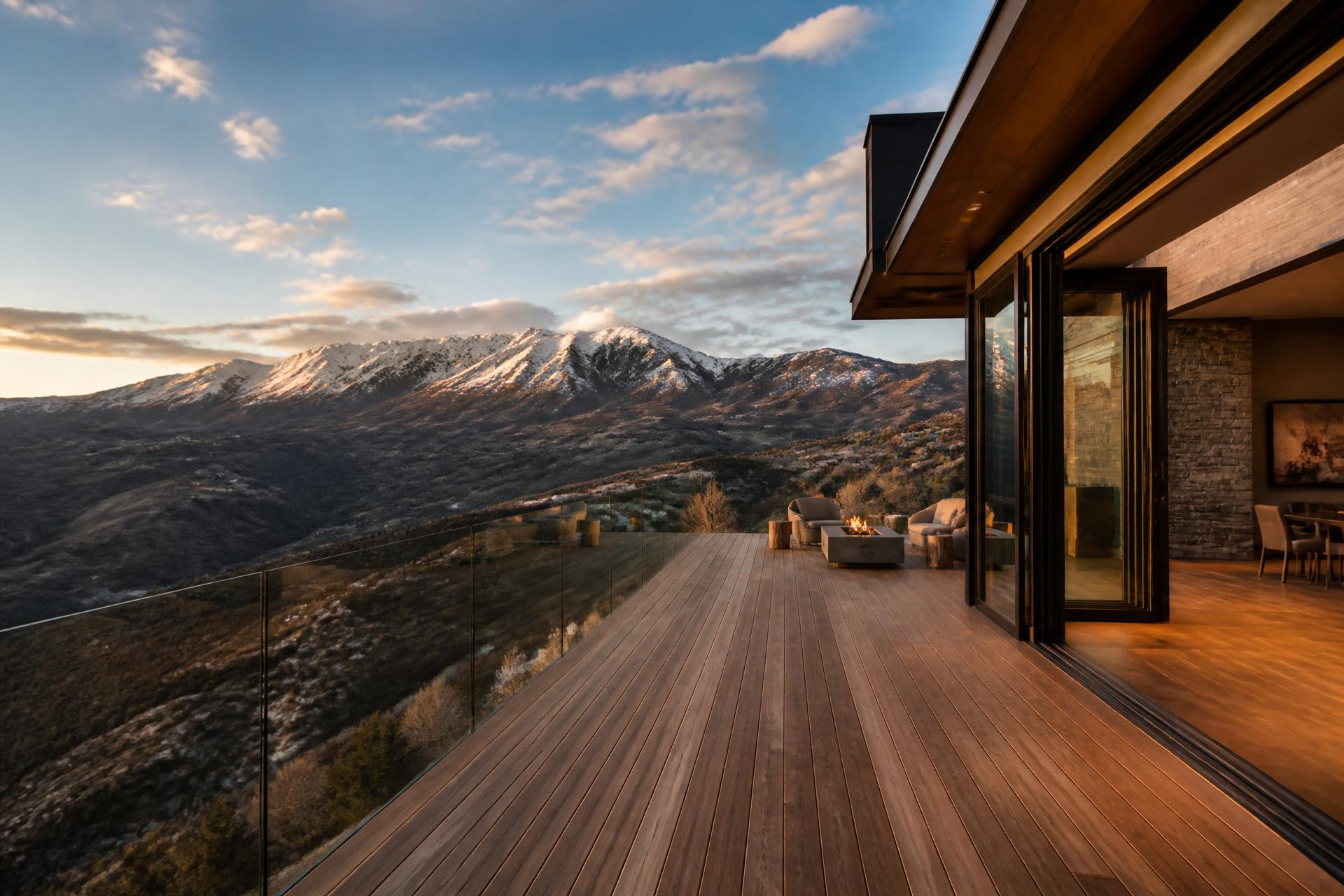
A deck belongs to the architecture when the line between interior and exterior is treated as a single design decision, not as two trades meeting at a threshold. The floor continues. The rail line tracks against the eave of the house. The board direction relates to the long axis of the great room behind it. The glass between the two reads as a thin membrane rather than a wall.
When this is done well, standing in the kitchen and standing on the deck feel like two parts of the same room. When it is done badly, the deck reads as the lower-quality cousin of the home, sitting outside the architecture rather than extending it. The deciding factor is not the cost of the boards. It is whether the deck was designed before the home was finished, or chosen after.
There are practical design moves that carry this. A continuous flooring line, with interior and exterior boards meeting at the same elevation under a flush sliding door, removes the visual step that announces, "you are now outside." A frameless glass guardrail allows the eye to travel uninterrupted from the room to the canyon, which on an Alpine view lot is the entire point of being there in the first place. Wide, full-length deck boards, run without seams where possible, prevent the patchwork look that makes a luxury deck read like a contractor platform within five years.
None of these are finishing touches. They are early architectural decisions, and they are exactly the moves that get lost when the deck is treated as a line item rather than as part of the home. The discipline of resolving them before construction is the same discipline that shapes the entire Modern International Builders practice.
What does a design-first builder notice on an Alpine deck that an average contractor misses?
A design-first builder notices the structural and detail decisions that quietly determine how an Alpine deck performs across thirty winters, while an average contractor often treats those same decisions as standard. The list is not glamorous, but it is where the long-term outcome lives.
Footing depth set for the Alpine frost line, not for a generic Utah standard. Cantilever distances calculated for the actual grade rather than rounded to the nearest framing convention. Ledger flashing detailed for the way snow actually melts and refreezes against the back wall of a mountain home. Deck board direction selected to wash water away from the home rather than back toward it. Rail post anchoring engineered for the lateral loads a frameless glass system imposes, not the simpler loads of a wood baluster system. Each of these is a quiet decision. Together they decide whether the deck still feels solid, true, and tight in year fifteen.
There is also the matter of how boards meet at the edges of the deck. A picture-framed perimeter, run with mitered corners and full-length internal field boards, reads as architecture. The same deck framed without that perimeter, with random butt seams across the field, reads as construction. The material cost difference is small. The visual and resale difference is enormous. The reason most decks do not have this detail is that it was never drawn during design, so it never made it into the field. Sophisticated buyers see the absence of it immediately, even if they cannot name what they are reacting to.
How does a well-designed Alpine deck behave as an investment?
A well-designed deck in Alpine functions as additional usable square footage and as resale confidence, while a poorly designed deck functions as a future cost. The financial logic is straightforward for the kind of buyer who tends to buy in this market. An outdoor room that reads as part of the home extends the felt size of the residence, often by more square footage than the most expensive interior addition. It photographs in the listing as another room rather than as a yard amenity. It makes the home feel larger and more considered the moment a future buyer steps through the great room.
A deck that does not read this way creates the opposite signal. It tells the future buyer that the home was built to a budget rather than to a vision, that the most powerful asset of the lot, the view, was not fully captured, and that a redesign is going to be part of any meaningful renovation. Even if the rest of the home is excellent, the deck communicates that the design discipline was uneven. In a price tier where buyers are paying for total consistency of intent, that signal costs money.
This is the same investment logic that shapes how MIB approaches every project. The work appreciates because the design and construction were correct. The owner holds that appreciation. A deck that was designed as part of the home, with the right structure underneath it and the right relationship to the view, is part of why the home is worth more than it cost to build. For the broader frame on this, see our perspective on what defines a luxury custom home builder in Utah.
Should you design the deck before or after the home is finished?
A deck should be designed at the same time as the home, in the same drawings, by the same team, because almost every detail that makes a deck feel architectural is decided in the framing of the house, not in the framing of the deck. By the time a home is finished, the most important decisions about its future deck have already been made, often by accident.
The threshold height between the great room floor and the deck surface. The location and width of the sliders that open onto it. The placement of the structural beam that the cantilever needs to land on. The way the roof line cuts above the deck and whether it provides shade in the afternoon or whether it dumps snow onto the seating area in February. The path the deck takes around the home to capture the morning view as well as the evening one. Each of these is set during the architectural phase of the house. Each of them is far more expensive to fix later than to draw correctly the first time.
This is the reason MIB treats decks as architecture rather than as add-ons. The decisions that make a deck great are early decisions, made in the same conversation as the home itself, by a team that is thinking about both at once. When a deck is approached this way, it is almost impossible to tell where the home ends and the outdoor room begins. That is the standard. For the design discipline behind it, see our build process.
What is the right first step for an Alpine homeowner considering a deck?
The right first step is a design conversation about the lot, the view, and the home, not a conversation about materials or square footage. Material choice is downstream of design. Square footage is downstream of how the deck steps with the grade and where it captures the view. Starting with the design question protects every later decision. Starting with the material question almost always produces a deck that looks correct on paper and feels wrong in person.
A design-first builder will walk the lot at the time of day that matters most to the owner, study the grade, photograph the sightlines, and only then propose what the deck wants to be. The proposal will look like architecture rather than a quote. That is the difference between a deck that belongs to the home and a deck that was added to it. Examples of this discipline in built work are in our portfolio.
Modern International Builders begins every Alpine project with that conversation. It is direct, it is grounded in design, and it is the reason the finished deck looks like it was always part of the home.
Modern International Builders
Utah's premier custom home builder, specializing in luxury residences throughout Park City, Alpine, Highland, and Draper. With over 20 years of experience, we transform visions into exceptional living spaces.
Learn more about our team →