
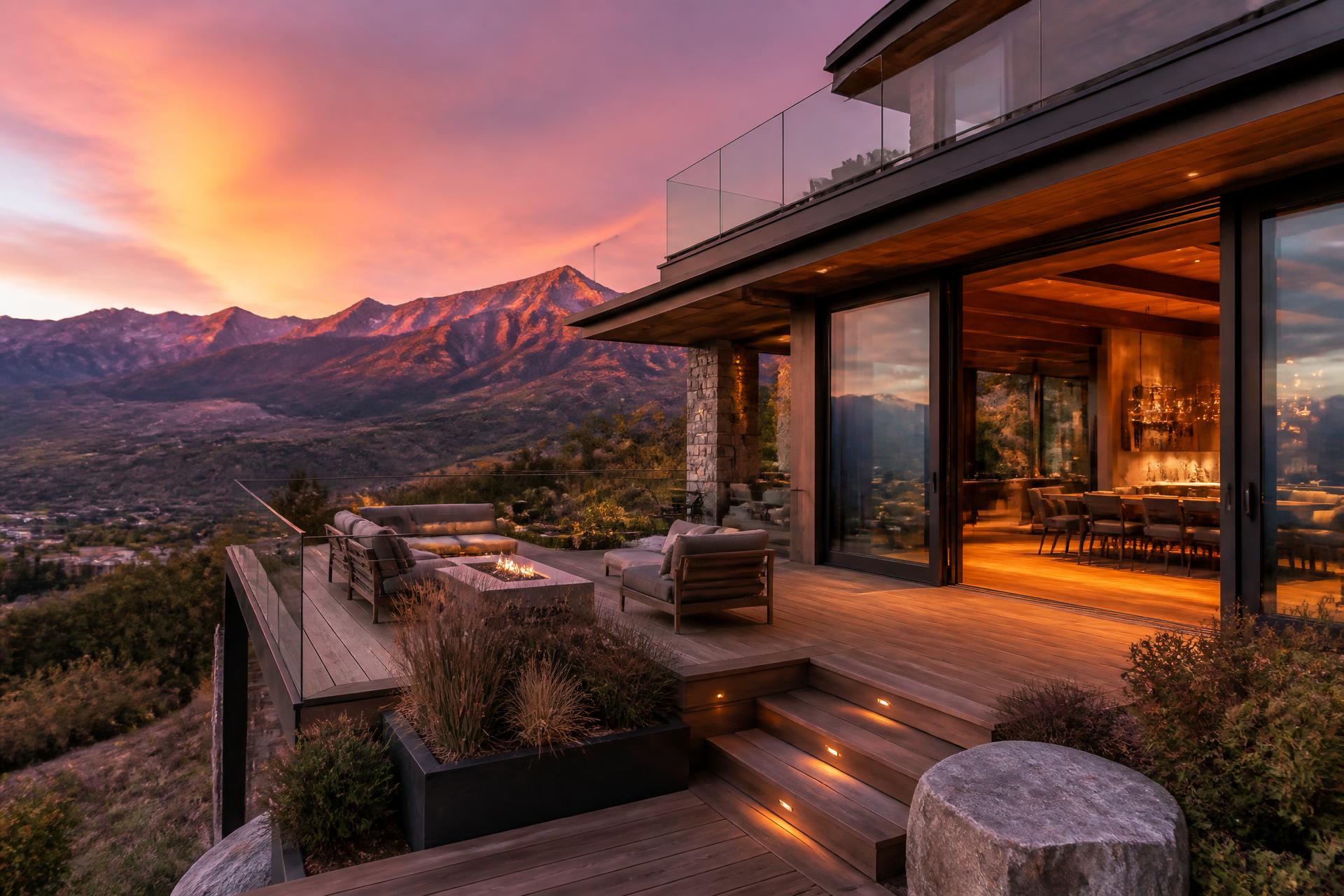
Designing the Alpine and Highland Outdoor Room: Decks, Grade, and the View That Sells the Home
An outdoor room is not about square footage. It is about the line between the home and the view. In Alpine and Highland, that line is the most valuable design decision on the property, and it is decided long before any deck board is selected. The owners who end up with an outdoor room that still feels right two decades after the home was finished are the ones who understood that early. The owners who end up with a deck that looks correct in the drawings and feels wrong in person are usually the ones who treated the outdoor room as a finishing decision rather than a design one.
This is the part of luxury outdoor living that the Utah market rarely names directly. Most conversations about decks and outdoor rooms start with materials, furniture, and amenities. Those are the visible parts of the work. But the felt quality of an outdoor room on an Alpine or Highland bench lot is set by something earlier and more architectural. It is set by how the deck reads the grade, captures the view, and dissolves the boundary between inside and outside. Get those three right and almost any later choice works. Get them wrong and no amount of finishing can recover the room.
Why is the line between home and view the entire design problem?
The line between the home and the view is the entire design problem because everything that makes an outdoor room feel luxurious is a function of how that line is drawn. A clear, thin, intentional line between the interior and the landscape lets the architecture extend outward and the landscape feel like part of the home. A heavy or accidental line splits the two, and the outdoor room ends up sitting outside the architecture rather than completing it.
In Alpine and Highland, the view is the most valuable single asset on the property. The deck is the room from which the view is consumed. The relationship between the two is therefore the single most consequential design decision the home will make, including the kitchen, including the primary suite. A perfectly executed great room with a poorly resolved deck sells the property short. A modestly scaled great room with a beautifully resolved deck sells the property up. The market understands this, even when it cannot articulate it.
Drawing the line correctly involves several quiet decisions made together. A flush threshold between the interior floor and the exterior deck so the eye does not register a step. A glass guardrail that disappears against the canyon. A continuous floor material direction so the interior and exterior boards read as one plane. A roof overhang detailed to give afternoon shade without dumping snow on the seating area in February. These decisions belong to the architectural phase of the home. They cannot be added later without compromise.
How do you read an Alpine or Highland bench lot?
Reading an Alpine or Highland bench lot means understanding the grade, the orientation, where the light lands at six in the morning and six in the evening, and how the deck steps with the slope rather than against it. A flat platform off the back of a house works on a flat lot. On a bench lot, it produces an outdoor room that feels disconnected from the land it sits on, regardless of how well it is built.
The grade tells you whether the deck wants to be a single elevation or two terraces stepping down with the slope. The orientation tells you where the morning sun arrives and where the afternoon shadow lands. On many Alpine and Highland lots, the most valuable seating moment is the evening, when the Wasatch lights up in pink and the deck becomes the best seat in the property. On others, it is the early morning, when the canyon air is still and the eastern light is at its softest. A design-first builder identifies which one the home should be designed around, because the deck cannot be optimized for both without compromising the architecture.
The deck steps with the slope when it is designed early enough to do so. A primary deck off the great room, a secondary terrace stepping down for a fire feature, a small lower platform meeting the landscape grade, all framed and detailed as one continuous architectural move, reads as inevitable on a bench lot. The same lot with a single platform deck stuck off the back wall reads as a missed opportunity. The difference is design, not budget.
How should an outdoor room be designed for Utah's seasons?
An outdoor room in Alpine or Highland needs to be designed for snow load, drainage, elevation-grade UV, and the temperature swings the property actually experiences across a year. Decks designed for photographs fail by year five in this climate. Decks designed for Utah specifically last across decades and still photograph correctly the day they sell.
Snow load is the part that flat-lot builders consistently underestimate. The structure under a bench-lot deck has to carry a winter that piles snow against the back of the home and onto any horizontal surface the roof line allows. Footings, ledgers, framing spans, and connections need to be sized for that reality, not for a generic minimum. The same logic applies to the railing system. A railing that holds beautifully in summer can deform under accumulated snow drift if the structure was not engineered for it.
Drainage is the quiet detail that decides whether the deck and the home stay tight or whether water finds its way into the structure over time. The deck surface needs to shed water away from the home. The flashing where the deck meets the wall needs to be detailed for how snow melts and refreezes in the shadow of the architecture. The grade beneath the deck needs to direct water away from the foundation. None of this shows in the finished photograph. All of it shows in the home's health at year fifteen.
Materials matter for the same reason. Elevation-grade UV is harder on surfaces than valley-grade light. Materials that hold color and dimensional stability under Utah's actual conditions, not under a national average, are the ones that allow the design intent to survive into the decades the homeowner is actually planning for. For the material layer of this argument in detail, see our perspective on deck materials for Utah's climate.
Why is the outdoor room often what a future buyer remembers?
On a view lot in Alpine or Highland, the outdoor room is often what a future buyer remembers from the showing, which is why it carries disproportionate weight in the property's perceived value. The kitchen, the primary suite, the finishes, all of these contribute. The moment the buyer stepped onto the deck and the Wasatch opened in front of them is the moment that anchors the property in their memory. That moment is either delivered by the design or it is missed.
A great outdoor room delivers the moment effortlessly. The buyer walks out of the great room, the threshold dissolves underfoot, the railing does not interrupt the view, the deck holds them at the right elevation above the slope, and the mountains are simply there. The room sells itself. A weak outdoor room produces a different version of the same moment. The buyer steps down rather than across. The view is framed by railing rather than by sky. The deck feels smaller than the room it extends. The moment is muted, and the property reads as less than it is.
For the financial frame on this, see our perspective on deck ROI in Utah. The short version is that the moment a future buyer remembers is the moment that sets the price they are willing to pay, and on a view lot the outdoor room is almost always where that moment lives.
What does the design phase look like before the shovel hits the ground?
The design phase for an Alpine or Highland outdoor room is months of intentional planning that resolves the deck before construction begins, in the same drawings as the home itself, by the same team. This is the window in which the project either earns its value or quietly loses it. Shorten this phase to save time and the savings are returned, with interest, in compromises during construction. Honor it and the construction phase becomes the disciplined execution of a vision that was already correct.
In practice this means walking the lot at the times of day that matter to the household. Studying the grade and the existing landscape. Photographing the sightlines from where the great room would sit. Drawing the threshold detail between interior and deck before the structural frame is committed. Selecting the railing system early enough that the framing supports it correctly. Resolving the roof line above the deck for shade, snow shed, and visual proportion together, not in three separate conversations. None of this is glamorous. All of it is what produces an outdoor room that belongs to the home it extends.
The same discipline shapes the entire Modern International Builders practice. The design phase is the work. The construction phase executes a vision that was already correct. The finished outdoor room reflects that order. For the broader frame on this discipline, see our build process and our portfolio.
What is the right first step for an Alpine or Highland homeowner?
The right first step for an Alpine or Highland homeowner thinking about an outdoor room is a design conversation about the lot, the view, and the home, not a conversation about materials or square footage. The room becomes great when those three are honored in the right order. It becomes generic when they are skipped.
Modern International Builders begins every Alpine and Highland engagement with that conversation. It is direct, it is grounded in design, and it is the reason the finished outdoor room reads as the most valuable room on the property.
Modern International Builders
Utah's premier custom home builder, specializing in luxury residences throughout Park City, Alpine, Highland, and Draper. With over 20 years of experience, we transform visions into exceptional living spaces.
Learn more about our team →