
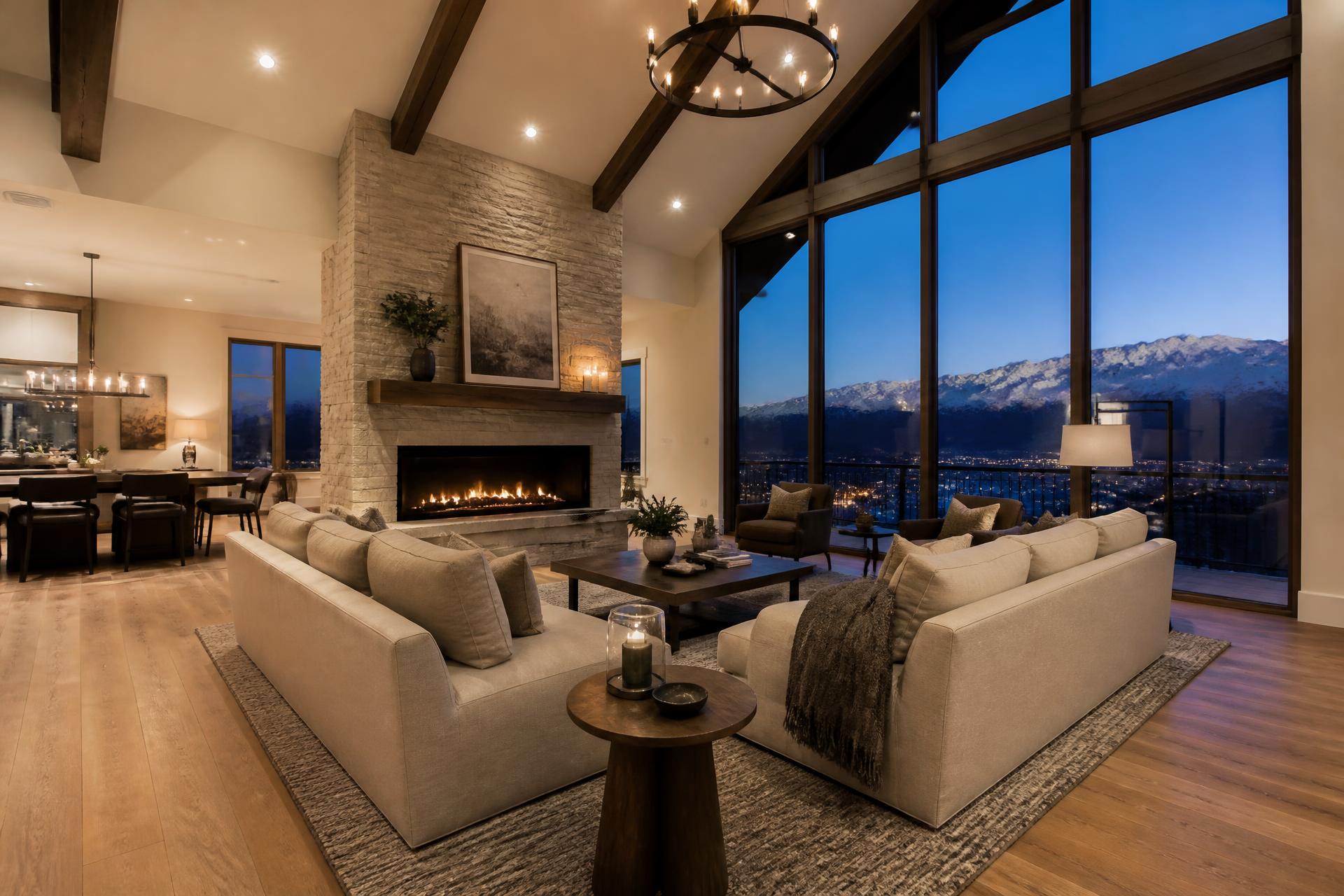
Luxury Whole-Home Remodels in Highland, Utah: When to Renovate Instead of Rebuild
Most of the Highland homes built during the early-2000s wave have very good bones and very dated layouts. The framing is sound. The lot is excellent. The location is increasingly hard to replace. Yet the floor plan was drawn for a different decade of living, the ceiling volumes are smaller than the present moment expects, the kitchen sits behind a wall it was never going to need, and the connection between the home and its Wasatch view is weaker than the property deserves. Owners often assume they have two options: live with the home as it is, or tear it down and start over. There is a third option, and for the right home it is almost always the better one.
A luxury whole-home remodel, designed with the discipline of a custom build, can transform a Highland house into the home it should have been the first time, at a cost that usually does not approach the cost of rebuilding and with a result that holds value better than many new construction projects in the same neighborhood. The decisive factor is not the budget. It is whether the project is framed as a design problem or as a construction problem.
Why is Highland uniquely suited to whole-home remodels right now?
Highland is uniquely suited to whole-home remodels because much of its existing housing stock is structurally healthy, sits on lots that are no longer being made, and was built before the current standards for ceiling volume, glass area, indoor-outdoor connection, and great-room flow became baseline expectations in the luxury market. The land cannot be replicated. The structure can usually be honored. The layout, the volume, and the light are the parts that need to change.
For an owner with a long horizon in Highland, this is a meaningful position. A teardown surrenders the existing setbacks, the established landscape, and the certainty that the lot already works the way the family has been living on it. A remodel preserves those advantages while replacing the parts of the home that were never going to age well. When the remodel is led by a design-first builder, the finished home reads as new construction with the credibility of a lot that has already proven itself.
The Highland-specific reality also matters. Zoning, lot coverage, easements, and the relationship to neighboring view corridors are all set. A remodel works within them with certainty. A rebuild has to renegotiate them, often with surprises that compress the design phase and push compromises into the construction phase. Working with a builder who already understands Highland's particulars is how the design phase stays the design phase rather than becoming a series of variance hearings. For our broader perspective on the market, see building in Highland.
When should you renovate and when should you rebuild?
The renovate-versus-rebuild decision is a design question before it is a construction question. The right way to answer it is to ask what the existing structure can carry, what the lot zoning will allow, and where the value of the finished home actually comes from. Once those three are understood honestly, the choice usually becomes clear.
A renovation is the right answer when the framing, foundation, and envelope are sound, when the home's footprint and orientation are already close to ideal, and when the changes that would unlock its value, opening the great room, raising the ceiling, expanding glass to the view, redesigning the primary suite, reworking the kitchen as the heart of the home, can be made within the existing shell with selective additions. In that situation, a remodel returns more value per dollar than a rebuild because it inherits everything that was already correct.
A rebuild becomes the right answer when the structure cannot carry the design the home wants to become, when the layout is fundamentally fighting the lot, or when the cost of working around the existing constraints would exceed the cost of starting clean. A design-first builder will say this directly when it is true. The honest answer protects the owner. A builder who recommends a remodel in every scenario, or a rebuild in every scenario, is selling a service rather than answering the question.
Where does the real value sit in a whole-home remodel?
The real value in a luxury whole-home remodel sits in flow, light, ceiling volume, and the connection between the home and its outdoor space. Finishes matter, but finishes are not where the home becomes more valuable. The home becomes more valuable when its bones start working the way the present moment expects.
Flow is the path the family takes through the home on a normal Tuesday evening. A great Highland remodel reworks that path so the kitchen, the family gathering space, the outdoor room, and the primary suite arrive in the order the household actually lives in. Light is how the home receives the Wasatch at six in the morning and again at six in the evening. New glass, repositioned windows, and a redesigned roof line can take a home that always felt heavy and make it feel airborne. Ceiling volume is the difference between a great room that compresses you and one that releases you. Raising a ceiling, even modestly, is one of the single highest-impact changes a remodel can make. Indoor-outdoor connection is where Highland's view becomes part of daily life rather than an occasional view from the back window.
These changes are also where the resale logic compounds. A buyer five years from now is not buying the cabinet door style. They are buying the way the home feels when they walk in. Flow, light, volume, and view define that feeling. A remodel that targets them creates value that holds. A remodel that targets finishes only creates value that dates. For the same principle applied to kitchens specifically, see our perspective on design-first kitchen remodels.
How does Highland's elevation and climate shape a remodel?
Highland's elevation means a whole-home remodel is also an opportunity to bring the envelope, the insulation, the windows, and the mechanical systems up to a standard the original build was never asked to meet. The exterior performance of a home at this elevation matters in a way it does not in a milder market. UV exposure, snow load, freeze-thaw cycles, and the swing between summer and winter temperatures all punish a building envelope that was specified to a 2003 minimum.
A design-first remodel addresses this quietly, in the parts of the home the eye never sees. Higher-performance window assemblies that hold the heat without dimming the view. Wall and roof insulation upgraded to what new construction in Highland would specify today. Mechanical systems sized for the actual demands of a home that now has more glass and more open volume than it did before. None of this is glamorous. All of it is part of why the renovated home is comfortable in February and quiet in July, and why the energy cost of running it does not climb when the square footage opens up.
This is the part of a remodel where a builder who is fluent in mountain construction is irreplaceable. A finish-focused remodeler can make a home look new. A design-first builder can make it perform new, which is what protects the investment across the next twenty years rather than the next twenty months.
What is it actually like to live through a whole-home remodel?
Living through a whole-home remodel is a relationship as much as a construction project, which is why the builder's communication discipline matters as much as the design discipline. Most Highland remodels of this scope are phased so the family can remain in part of the home during portions of the work, or relocate cleanly for defined windows. Either way, the difference between a successful experience and a painful one is whether the builder tells the truth about schedule, answers decisions the same day, and treats the home as a place the owner lives in rather than as a job site that happens to be occupied.
A design-first builder approaches the build itself with the same discipline that produced the design. The schedule is realistic from day one rather than optimistic until day ninety. Trade sequencing is planned to keep the active work area contained. Daily site condition is treated as a standard, not as a courtesy. The owner always knows where the project stands. This is not extra. It is part of what the homeowner is paying for in this tier of work.
The relationship pillar runs through every MIB engagement for exactly this reason. A whole-home remodel is too consequential to be run on assumption. The credibility of the build is built every week, in how the owner is communicated with, how problems are surfaced, and how decisions are handled. The finished home reflects that discipline as much as it reflects the design.
What does the investment math look like on a Highland remodel?
A design-led whole-home remodel in Highland tends to increase the home's value disproportionately to the money spent on it, because the changes that drive the value, flow, light, volume, envelope, indoor-outdoor connection, are precisely the changes a future buyer is willing to pay for. The same dollars spent on cosmetic updates without addressing the underlying design return less, because they do not change what the home is. They only change how it looks for a season.
This reframes the entire cost conversation. The right measure of a Highland remodel is not the budget. It is what the home becomes, what it sells for if the family chooses to sell, and how it carries the owner across the next decade or two of living in it. A remodel done correctly creates an asset that has appreciated through the quality of the work. The owner holds that appreciation. This is the same logic that makes a custom home a long-horizon investment rather than an expense, and it applies here just as cleanly. For the parallel framing on new construction, see what to look for in a Utah custom home builder.
Where should a Highland homeowner start?
A Highland homeowner considering a whole-home remodel should start with a design conversation rather than a bid. The first question is not what the project will cost. It is what the home wants to become. Once that is understood, the construction question becomes answerable. Without it, every bid is guessing at a target nobody has defined.
Modern International Builders begins every Highland remodel with that conversation. It is grounded in the lot, the existing home, the way the family lives, and the long-term value the project is meant to create. The design phase that follows is the most valuable part of the project, because it is where the right answer is identified before construction commits to it.
Modern International Builders
Utah's premier custom home builder, specializing in luxury residences throughout Park City, Alpine, Highland, and Draper. With over 20 years of experience, we transform visions into exceptional living spaces.
Learn more about our team →